 Twitter
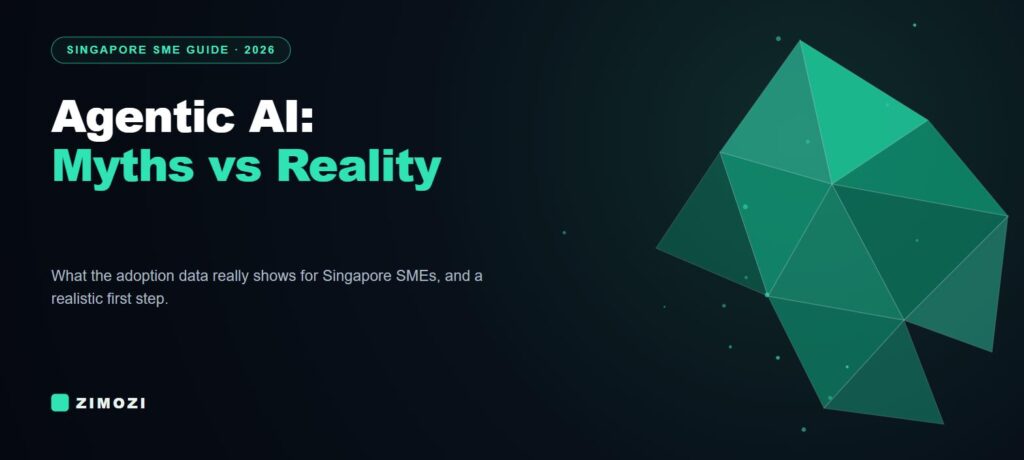
Agentic AI for Singapore SMEs has become the most talked-about idea in Singapore’s tech scene this year, and the numbers back up the buzz. Deloitte reports that 72 percent of Singapore businesses now plan to deploy agentic AI within two years, up sharply from just 15 percent previously, while separate research from CRN Asia finds that 89 percent of local businesses believe the technology has moderate to high potential to transform how they operate.
Look closer at the same wave of research, though, and a gap appears: actual production use still trails far behind the plans, and a meaningful share of leaders point to a skills gap as the main blocker. For a Singapore SME trying to work out what’s genuinely useful versus what’s hype, that gap between ambition and reality is exactly where this guide lives.
What Agentic AI Actually Means
Most of the AI tools Singapore SMEs adopted over the last two years were prompt-based: you type a request, a model replies, and a person decides what happens next. An agent works differently. It is given a goal, breaks that goal into steps, calls the tools or systems it needs (a CRM, an inbox, a spreadsheet, an API), checks its own output against the goal, and loops through several actions before handing a finished result back to a person. That capacity to plan and act across multiple
Myth vs Reality: Separating the Hype From What’s Actually Happening
Myth: agents are about to replace most of your team. Reality: the roles being reshaped first are narrow and repetitive, such as sorting inbound enquiries or matching invoices to purchase orders. Every credible 2026 deployment still keeps a person reviewing exceptions and approving anything that touches money, customers, or compliance. The near-term effect is fewer hours spent on coordination busywork, not fewer people.
Myth: agentic AI is plug-and-play from day one. Reality: an agent is only as good as the data and workflow it plugs into. Most SME projects spend the first few weeks tidying up records, defining what “done” looks like for a task, and connecting systems that were never built to talk to each other. Skipping that groundwork is the single biggest reason pilots stall.
Myth: this is only affordable for large enterprises. Reality: the cost of a first agentic project has dropped considerably. Pay-as-you-go model APIs, off-the-shelf agent platforms, and co-funding through Singapore’s SME digitalisation grants have brought a scoped pilot within reach of companies with 10 to 200 staff, which is exactly the segment Deloitte and CRN Asia found planning to move in the next two years.
Myth: one agent can safely run an entire business process end to end. Reality: the deployments actually in production today are narrow by design. An agent handles one well-defined workflow, hands off to a person at clear checkpoints, and earns wider scope only after it has proven reliable in that smaller job. Businesses that try to skip straight to full autonomy are exactly the ones running into the skills and governance gaps the surveys keep flagging.
Where Agentic AI for Singapore SMEs Pays Off Today
The use cases gaining traction in Singapore right now share a common thread: a clear trigger, a bounded set of actions, and an obvious way to check the result. Customer support triage is a common starting point, where an agent reads incoming enquiries, classifies urgency, drafts a first response, and routes anything sensitive to a human.
Finance teams are using agents to match invoices against purchase orders and flag mismatches before payment, cutting down hours of manual reconciliation. Retail and logistics operators are trialling agents that watch stock levels and supplier lead times, then draft reorder recommendations instead of waiting for someone to notice a shortfall.
Sales teams are using them to qualify inbound leads and keep CRM records current, so follow-ups happen faster and nothing falls through the cracks. None of these replace judgment; they remove the tedious first pass so people can spend their time on the decisions that actually need them.
A Realistic First Step
Skip the temptation to launch several pilots at once. Pick one workflow that is well understood, painful enough to matter, and low-risk enough to get wrong occasionally. Write down what success looks like in plain numbers, such as response time or hours saved per week, before building anything. Keep a person checking the agent’s output at a defined point until it has earned trust, and only then widen its scope or move to a second workflow. This is the same sequencing behind the government-backed grant support mentioned earlier: fund a small, well-defined project, prove the return, and expand from there.
Where Zimozi Fits In
We help Singapore SMEs scope and build exactly this kind of first agentic AI project: one well-defined workflow, connected cleanly to your existing systems, with a human checkpoint built in from day one. If you are weighing where agentic AI for Singapore SMEs could realistically fit into your operations, we are happy to walk through it with you.
Ready to Explore Agentic AI for Your Business?
Not sure where agentic AI for Singapore SMEs could realistically fit into your operations? Book a free call with our team and we’ll help you scope one well-defined pilot, connect it to your existing systems, and set a clear way to measure the results of your agentic AI for Singapore SMEs pilot.