 Twitter
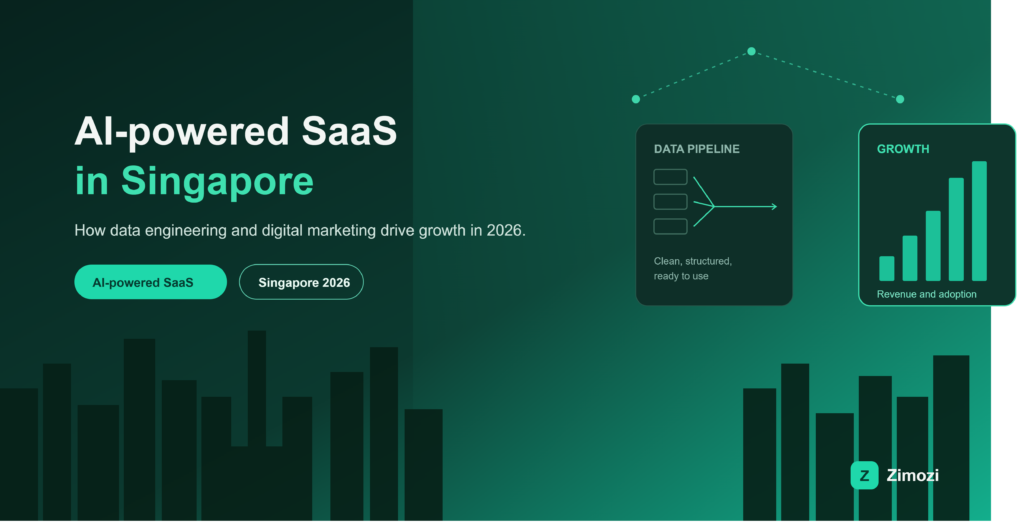
AI-powered SaaS Singapore is changing how businesses build software, manage data, and approach digital marketing in 2026.
SaaS products are increasingly incorporating AI into their core workflows. At the same time, the data pipelines behind these products are becoming an important part of the technology foundation.
Digital marketing is also becoming more dependent on reliable customer and product data.
When these three areas are connected, businesses can build a stronger relationship between their product, data, and marketing activities.
The Shift From SaaS Tools to AI-Powered SaaS Singapore Platforms
Traditional SaaS products generally provide software through a cloud-based platform. AI-powered SaaS products can go further by using AI within specific business workflows.
For example, a SaaS platform could use AI to classify customer requests, process documents, identify patterns, generate summaries, or support business decisions.
The important question is not whether a product contains AI. The more useful question is whether AI solves a real problem within the product.
AI-powered SaaS Singapore solutions can bring AI directly into business workflows instead of using AI as a separate tool.
This requires more than selecting an AI model. The product also needs reliable data, suitable architecture, secure integrations, and a clear understanding of how users will interact with the system.
Why Data Engineering Is the Foundation
AI features often receive most of the attention during product development. Data engineering usually receives less attention until a product faces problems with data quality or availability.
Reliable data pipelines are important because AI features need consistent and timely information to work effectively.
A SaaS product’s AI depends heavily on the data engineering underneath it.
Production data can be different from the clean data used in a demonstration. It may arrive late, contain missing information, or come from different systems with different formats.
For a growing SaaS business in Singapore, the data engineering layer needs to support reliable ingestion, storage, processing, quality, governance, and access.
Build Reliable Data Pipelines
A SaaS platform may receive data from many sources, including CRM systems, payment platforms, product usage events, databases, and third-party APIs.
A well-designed data pipeline can bring this information together in a structured way.
Businesses should also consider what happens when an external system changes its data format or becomes temporarily unavailable.
Create a Data Foundation for AI and Reporting
The same data may be required for dashboards, business reporting, analytics, and AI features.
A suitable data architecture can help teams avoid maintaining separate and disconnected datasets for every business function.
AI-powered SaaS Singapore products can use this data foundation to support AI features while giving business teams access to useful information for reporting and analysis.
Consider Data Quality and Governance
Poor-quality data can affect both business reporting and AI features.
Businesses should consider data access, quality, retention, security, and governance when designing their data systems.
Businesses handling personal data in Singapore can refer to the Personal Data Protection Commission (PDPC) for relevant data protection guidance.
Digital Marketing Has Changed Because the Data Changed
Digital marketing increasingly depends on the quality of customer and business data available to marketing teams.
Marketing teams may use information from websites, CRM systems, advertising platforms, customer interactions, and product usage.
When these sources are connected, businesses can develop a clearer understanding of how customers interact with their products.
The challenge is making sure the information is accurate, organised, and available to the people who need it.
How Data Engineering Supports Digital Marketing
Data engineering can connect product data with marketing data so teams can work with a more complete view of customer activity.
For example, a business could connect:
-
CRM records
-
Website activity
-
Product usage
-
Campaign information
-
Customer interactions
-
Sales information
This can help marketing teams understand which activities are associated with customer engagement.
AI-powered SaaS Singapore platforms can connect customer and product data with marketing workflows to support more relevant campaigns.
Personalise Based on Customer Behaviour
Customer behaviour can provide useful information for marketing activities.
For example, a SaaS company could identify customers who actively use a particular feature and create educational content or communication around that feature.
The purpose is not to collect as much data as possible. It is to use relevant information responsibly to support useful customer experiences.
Improve Lead Quality
Connected data can also help businesses understand the quality of leads generated through different marketing channels.
Marketing teams can compare campaign information with CRM and sales data instead of relying only on initial lead volume.
This can provide a more complete picture of which channels are producing relevant opportunities.
Support Better Content Decisions
Businesses can also use customer and product data to identify questions, problems, and topics that matter to their audiences.
This information can support content planning and help marketing teams create material that is relevant to actual customer needs.
How These Three Pieces Work Together in Practice
Consider a SaaS company in Singapore serving businesses in industries such as finance or logistics.
The company may develop an AI feature that identifies unusual patterns in customer data.
For this feature to work effectively, the data engineering layer needs to provide reliable and timely information.
The marketing team can then use relevant product information to understand which customers benefit most from the feature.
This information can support marketing campaigns, educational content, and customer communication.
The result is a connected workflow where product development, data engineering, and digital marketing support each other.
AI-powered SaaS Singapore development works best when the product, data engineering, and marketing strategy are planned as connected parts of the same system.
Where Singapore Businesses Can Get It Wrong
Several problems can make AI-powered SaaS projects more difficult than expected.
Building AI Before Preparing the Data
An AI feature may work well with a small, clean dataset during development.
Production data can be much more complicated.
If the underlying data is incomplete, inconsistent, or difficult to access, the AI feature may not perform as expected.
Keeping Product and Marketing Data Separate
When product, sales, and marketing teams use completely separate datasets, it can be difficult to understand the complete customer journey.
A connected data foundation can reduce unnecessary duplication and make information easier to use across teams.
Underestimating Data Engineering
AI models are only one part of an AI-powered product.
Businesses also need to consider pipelines, storage, data quality, security, monitoring, and governance.
These technical foundations can determine how easily a product can support new AI features later.
Trying to Automate Everything
Businesses do not need to add AI to every part of a product.
A better approach is to identify one clear business problem and develop a focused solution around it.
Once the solution has been tested, the business can decide whether additional use cases are worth developing.
A Practical Roadmap for the Next 12 Months
1. Review Your Existing Data
Start by identifying where customer, product, sales, and marketing data currently exists.
Look for duplicated information, missing data, disconnected systems, and manual processes.
2. Choose One Practical AI Use Case
Select one problem where AI can provide a measurable benefit.
This could involve customer support, document processing, workflow automation, recommendations, or another clearly defined use case.
3. Build the Required Data Pipeline
Once the use case is defined, identify the data it requires.
Build the necessary pipeline and data structure around that specific requirement instead of creating unnecessary complexity.
4. Connect Product and Marketing Data
Identify which product and customer information can help marketing teams understand user behaviour and customer needs.
Only use information that is appropriate for the intended purpose.
5. Measure the Results
Define measurable outcomes before expanding the project.
Depending on the use case, this could include time saved, improved workflow completion, better lead quality, reduced manual work, or increased product engagement.
Frequently Asked Questions
What does AI-powered SaaS mean?
AI-powered SaaS refers to software delivered as a service that uses artificial intelligence within its product features or workflows.
The AI should solve a practical problem rather than simply being added as a separate feature.
Why does a SaaS company need data engineering?
Data engineering helps businesses collect, process, organise, and manage the information required by their applications, analytics, and AI features.
Without a reliable data foundation, AI features can become difficult to maintain and improve.
How can data engineering support digital marketing?
Data engineering can connect information from systems such as CRM platforms, websites, product analytics, and marketing platforms.
This can give marketing teams more useful information for understanding customers and evaluating campaigns.
Is AI-powered SaaS suitable for small businesses?
Yes. A small business does not necessarily need a large enterprise data platform.
It can start with one practical use case and build the required data and software foundation around that need.
How should a business start an AI-powered SaaS project?
Start by identifying the business problem, target users, required data, and expected outcome.
Then define the smallest useful product or feature that can be developed and tested.
Where Zimozi Fits In
Yes. You can update that section.
Replace your current “Where Zimozi Fits In” section with this:
Where Zimozi Fits In
Zimozi can support businesses developing AI-powered software products and connected digital solutions.
Depending on the project, this can include AI development, SaaS solutions, data engineering, and web development.
The technical approach should be based on the product requirements, available data, target users, and business objectives.
For businesses planning an AI-powered SaaS product, the first step is to identify the specific problem the product needs to solve.
From there, the product architecture, data foundation, AI capabilities, and marketing requirements can be planned around the same objective.
AI-powered SaaS Singapore can bring SaaS, AI, data engineering, and digital marketing together into a connected digital product strategy.