 Twitter
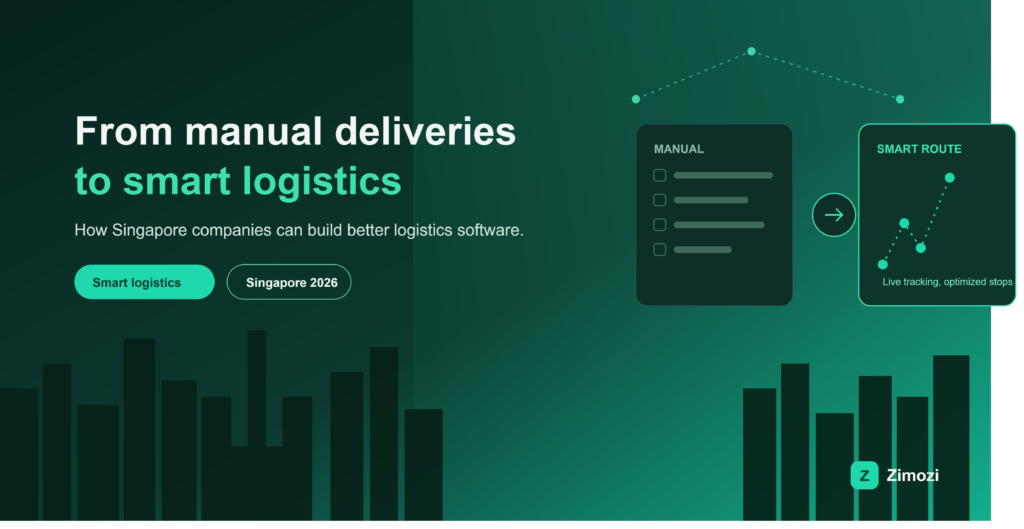
Logistics software Singapore can help businesses connect fleet tracking, warehouse management, delivery operations, route optimisation, and driver applications in one digital system. Instead of managing different parts of the delivery process through separate tools, businesses can build connected workflows that give teams better access to operational information.
Logistics operations depend on accurate information. Teams need to know where vehicles are, what has been delivered, what is still in the warehouse, and how deliveries are progressing. When these activities depend heavily on spreadsheets, phone calls, or disconnected systems, managing daily operations can become more difficult.
Zimozi provides logistics software development in Singapore and Southeast Asia, covering delivery and fleet tracking, warehouse and inventory systems, AI-powered route optimisation, and driver and customer applications.
Businesses looking for logistics software Singapore solutions should first identify the delivery and warehouse processes they want to improve.
What Is Logistics Software?
Logistics software is a digital system that helps businesses manage the movement, storage, tracking, and delivery of goods.
Depending on the business, a logistics platform can include:
- Fleet and vehicle tracking
- Delivery management
- Warehouse and inventory management
- Route planning
- Driver applications
- Customer delivery updates
- Proof of delivery
- Business system integrations
- Operational reporting
The exact features depend on the company’s workflow. A delivery company may need fleet tracking and driver applications, while a warehouse-focused business may need stronger inventory and fulfilment features.
A good logistics platform connects these activities instead of treating them as separate processes.
Logistics Software Singapore: Why Connected Systems Matter
Logistics software Singapore businesses use should be designed around the actual movement of goods and information.
A typical delivery process can involve several steps:
- Receiving an order
- Preparing the item in the warehouse
- Assigning the delivery
- Planning the route
- Giving the driver the delivery information
- Delivering the item
- Recording proof of delivery
- Updating the customer
- Recording the completed delivery
When these activities are handled through separate systems, employees may need to enter the same information more than once.
A connected platform can bring these workflows together and give operations teams a clearer view of deliveries, vehicles, warehouse activity, and customer updates.
The Land Transport Authority (LTA) manages Singapore’s land transport infrastructure and systems.
Key Features of Logistics Software
1. Fleet and Delivery Tracking
Fleet tracking can help operations teams monitor vehicles and deliveries.
A logistics platform can provide information about active deliveries, vehicle locations, delivery status, and proof of delivery. This can help operations teams coordinate deliveries and provide customers with useful delivery information.
Zimozi’s logistics software service includes live maps, proof of delivery, and customer notifications.
A well-designed logistics software Singapore platform can bring vehicle and delivery information into a central dashboard.
2. Warehouse and Inventory Management
Warehouse activities are closely connected to delivery operations.
A logistics system can help manage inventory, scanning, fulfilment, and warehouse activities. Connecting warehouse information with delivery workflows can reduce the need to maintain separate records.
For example, when an item is prepared for delivery, the relevant information can become available to the delivery management system.
3. AI Route Optimisation
Route planning can become more complicated as the number of deliveries increases.
AI-based route optimisation can help businesses analyse delivery requirements and support route planning.
A practical approach is to begin with a specific use case, such as supporting route planning for a particular delivery operation.
The business can then evaluate the system using measures that matter to its operation, such as planning time, distance, delivery schedules, or vehicle utilisation.
4. Driver Applications
Drivers need access to delivery information while working in the field.
A driver application can allow drivers to:
- View assigned deliveries
- Access delivery information
- Update delivery status
- Record proof of delivery
- Send relevant information to the operations team
The application should be simple and designed around the driver’s actual workflow.
5. Customer Delivery Updates
Customers also need visibility into their deliveries.
A logistics platform can provide delivery updates through a customer application, tracking page, or notifications.
This can make it easier for customers to understand the status of their orders without repeatedly contacting the business.
The right approach depends on the business. A customer app may be useful for some companies, while a web-based tracking page or notifications may be enough for others.
Integrating Logistics Software With Existing Systems
A logistics platform does not always need to replace the systems a business already uses.
Companies may already have ecommerce platforms, ERP systems, POS systems, accounting software, or carrier systems.
Logistics software Singapore businesses build can connect these systems through APIs and other integrations, depending on the technical requirements.
A connected workflow could look like this:
Order received → Warehouse processing → Delivery assignment → Driver app → Delivery tracking → Proof of delivery
The exact integration depends on the systems used by the business and the information that needs to move between them.
For businesses that need a web-based operational platform, Zimozi also provides web development services covering web platforms, web apps, APIs, hosting, security, and related development work.
How to Build Logistics Software
Building logistics software should begin with the business workflow rather than a long list of technical features.
Step 1: Understand the Current Workflow
Start by documenting how orders, inventory, deliveries, drivers, and customers are currently managed.
Identify where employees:
- Enter information manually
- Move information between systems
- Check delivery status
- Communicate with drivers
- Update customers
- Track inventory
This helps define what the new software actually needs to solve.
Step 2: Select the Core Features
The first version does not need to include every possible feature.
One business may start with delivery tracking and driver management.
Another business may need warehouse and inventory management first.
The initial features should be based on the most important operational requirements.
Step 3: Design the User Experience
Different users need different information.
An operations manager may need a dashboard showing deliveries and vehicles, while a driver may only need a simple mobile application showing assigned deliveries.
The interface should therefore be designed according to each user’s role.
Zimozi also provides mobile app development services for businesses that need mobile applications connected to their wider software systems.
Step 4: Build Required Integrations
If the logistics platform needs information from an ecommerce, ERP, POS, or carrier system, integrations should be planned during development.
This helps determine what information needs to move between systems and how the different workflows should operate.
Step 5: Test Real Logistics Workflows
Logistics software needs to work in practical situations.
Testing should cover different delivery scenarios, user roles, mobile devices, integrations, data updates, and exceptions.
Quality assurance is important when different users and systems depend on the same platform.
Where AI Can Be Used in Logistics
Logistics software Singapore projects can include AI when there is a clear operational problem that can be supported by available data.
Route optimisation is one example. AI can analyse delivery information and support route planning.
Other possible areas can include document processing and predictive maintenance, depending on the business requirements and available data.
AI should not be added simply because it is available. A better approach is to identify a specific problem, understand the available data, and then determine whether AI is appropriate.
For example:
Problem: Delivery routes require significant manual planning.
Possible approach: Use delivery information to support route optimisation.
Measurement: Track relevant operational measures such as planning time, distance, or delivery performance.
This gives the business a clearer way to evaluate the technology.
Building Logistics Software That Can Scale
A logistics platform may start with one workflow and expand over time.
A business might initially build delivery tracking and later add:
- Warehouse management
- Driver applications
- Customer tracking
- Route optimisation
- Business integrations
- Operational reporting
The software should therefore be designed with future requirements in mind without making the first version unnecessarily complicated.
Security and Data Management
Logistics platforms can handle business and customer information, so security should be considered during development.
Important areas can include:
- User access controls
- Secure authentication
- Data protection
- API security
- Activity logging
- Backup and recovery
- Secure integrations
If a logistics platform collects, uses, or discloses personal data, businesses should also consider the requirements that apply to their activities under Singapore’s data protection framework.
The Personal Data Protection Commission provides guidance and resources for organisations on data protection obligations and practices.
When Should a Business Build Custom Logistics Software?
Custom logistics software can be useful when existing tools do not fit a company’s workflow or when several systems need to work together.
A business might consider custom development when it needs:
- A specific delivery workflow
- Custom fleet tracking
- Warehouse and delivery integration
- Driver applications
- Customer applications
- AI route optimisation
- Integration with existing business systems
- A platform that can expand as operations grow
For smaller or simpler operations, an existing logistics platform may be enough.
Custom development becomes more relevant when a business has specific processes that standard software cannot support effectively.
How Zimozi Can Help With Logistics Software Development
Logistics software Singapore businesses need can vary depending on the type of operation, delivery model, warehouse process, and existing technology.
Zimozi provides logistics software development for businesses in Singapore and Southeast Asia. Its logistics service covers delivery and fleet tracking, warehouse and inventory systems, AI route optimisation, and driver and customer applications.
Zimozi also provides related services including mobile app development, web development, artificial intelligence, SaaS solutions, data engineering, and DevOps and automation.
These capabilities can be combined depending on the project. A logistics platform may need a web dashboard for operations teams, a mobile application for drivers, integrations with existing systems, and AI for a specific optimisation workflow.
The first step is to understand the existing logistics process and identify which areas should be improved through software.
Conclusion
Logistics software Singapore solutions can connect delivery, fleet, warehouse, driver, and customer workflows into one structured system.
The right solution does not need to automate everything from the beginning. A focused first version can address one important operational problem and provide a foundation for future development.
For businesses considering custom logistics software, the starting point is to map the current workflow, identify the main operational gaps, and define the features required to solve them.
Zimozi provides logistics software development covering fleet and delivery tracking, warehouse systems, route optimisation, integrations, and driver and customer applications.