 Twitter
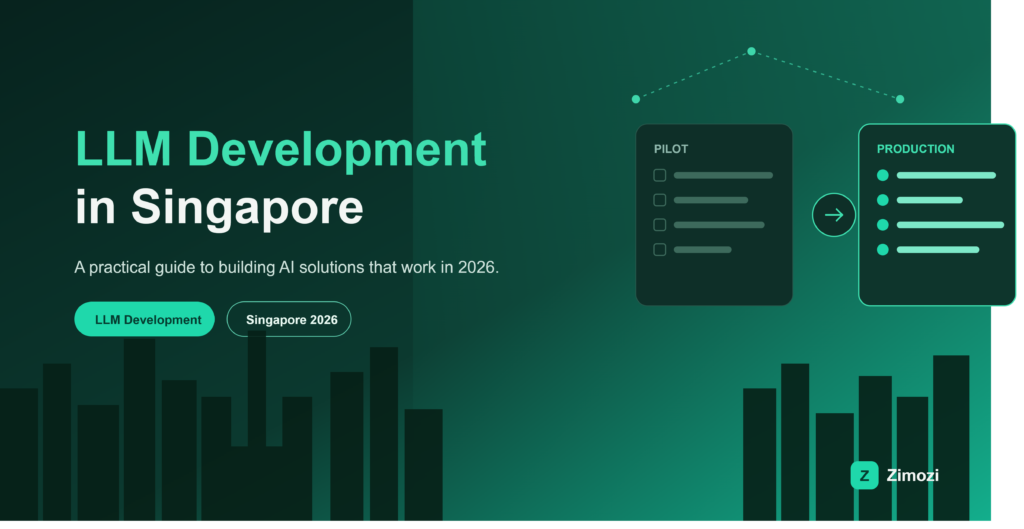
LLM development Singapore is helping businesses build AI applications that can understand, process, and generate human-like text. Large Language Models, or LLMs, can support customer service, document processing, internal knowledge systems, content workflows, and business automation.
For Singapore businesses, building an LLM solution is not simply about choosing an AI model. Businesses also need to consider their use case, data, integrations, security, cost, and how the system will be managed after launch.
What Is an LLM?
A Large Language Model is an AI model trained on large amounts of data to understand and generate language.
LLMs can support tasks such as:
- Answering questions
- Summarising information
- Generating text
- Extracting information from documents
- Classifying content
- Translating text
- Supporting customer conversations
- Searching business information
Businesses can access existing LLMs through APIs and build applications around them instead of training a large model from scratch.
Why Are Businesses Using LLMs?
Many business processes involve large amounts of text and information.
Employees may spend time reading documents, responding to repetitive questions, searching internal information, or preparing content.
An LLM application can assist with these tasks.
For example, a company could build an internal AI assistant that allows employees to ask questions about company policies, product documentation, or internal procedures.
The goal should be to solve a specific business problem rather than introduce AI without a clear purpose.
LLM development Singapore can help businesses automate language-based tasks while keeping their existing software workflows in place.
LLM Use Cases for Singapore Businesses
LLM development Singapore projects can support different departments and industries.
AI Customer Support
Businesses can use LLM-powered applications to answer common customer questions.
A customer support assistant could help with:
- Product information
- Frequently asked questions
- Basic troubleshooting
- Service information
- Order-related questions
- Support ticket classification
The system can also pass complex cases to human support staff.
Internal Knowledge Assistants
Businesses often have information stored across documents, websites, databases, and internal systems.
An AI knowledge assistant can help employees find relevant information through natural-language questions.
For example, an employee could ask:
“What is the process for handling a customer refund?”
The application could search approved company information and provide a response based on the available documents.
Access controls should be used to ensure employees only receive information they are authorised to access.
Document Processing
LLMs can support businesses that work with large numbers of documents.
Potential applications include:
- Document summarisation
- Information extraction
- Document classification
- Contract analysis assistance
- Report summarisation
- Form processing
For sensitive or important documents, human review may still be required.
Content and Marketing Assistance
LLMs can help marketing teams with tasks such as:
- Drafting articles
- Creating product descriptions
- Preparing email drafts
- Summarising research
- Generating content ideas
- Rewriting existing content
Human review is important to check accuracy, brand requirements, and factual claims before publishing.
A well-planned LLM development Singapore project can support customer service, document processing, and internal knowledge management.
What Is RAG?
Retrieval-Augmented Generation, commonly known as RAG, allows an AI application to retrieve relevant information from a connected knowledge source before generating an answer.
For example, a business could connect an AI assistant to its internal documentation.
When a user asks a question, the system can:
- Receive the question.
- Search the relevant information.
- Retrieve useful documents or passages.
- Provide that information to the LLM.
- Generate a response using the retrieved information.
RAG can be useful when a business wants an AI application to work with its own information without retraining the underlying model every time its documents change.
RAG vs Fine-Tuning
RAG and fine-tuning are different approaches.
RAG is useful when an application needs to retrieve information from a knowledge base or external data source.
Fine-tuning involves additional training of a model using a specific dataset. It can be considered when a business needs particular behaviour, formatting, or task performance.
The appropriate approach depends on the application.
Some projects may use RAG, some may use fine-tuning, and others may combine multiple AI techniques with traditional software logic.
Choosing the Right LLM
Businesses have different LLM options available through APIs and other deployment methods.
When selecting a model, consider:
- Accuracy
- Response speed
- Cost
- Context capacity
- Language support
- API availability
- Security requirements
- Data handling
- Integration requirements
A smaller model may be sufficient for a simple classification or extraction task, while a more capable model may be appropriate for more complex applications.
The model should be selected based on the actual business requirement.
Security and Data Privacy
LLM applications can process customer information, business documents, employee data, and other sensitive information. Security and data privacy should therefore be considered from the beginning of development.
Businesses can refer to the Personal Data Protection Commission (PDPC) for information about Singapore’s personal data protection framework.
Important areas include:
- Authentication
- Access controls
- Encryption
- Secure API communication
- Data storage
- Logging
- Monitoring
- Data retention
- User permissions
Businesses should also understand how data is processed and stored by third-party AI providers.
For LLM development Singapore, organisations should consider applicable data protection and security requirements when designing the application.
Building an LLM Application
A practical LLM development process can be divided into several stages.
1. Define the Use Case
Start by identifying the business problem.
For example:
Employees spend too much time searching through internal documents.
The proposed solution could be an internal AI knowledge assistant.
2. Identify the Data
Determine what information the application needs.
This could include:
- Business documents
- Product information
- FAQs
- Databases
- Knowledge bases
- CRM information
- Internal procedures
3. Select the AI Approach
Depending on the use case, the solution may use:
- An LLM API
- RAG
- Fine-tuning
- AI agents
- Traditional software logic
- A combination of technologies
4. Develop the Application
The development team can connect the AI model with the required data sources, databases, APIs, and business systems.
The application may also include a web interface, mobile interface, or integration with existing business software.
5. Test the Application
Testing should evaluate:
- Response quality
- Accuracy
- Security
- Performance
- Access permissions
- Incorrect responses
- Error handling
- Integration reliability
6. Monitor and Improve
An LLM application should be monitored after launch.
Businesses can review user feedback, incorrect responses, usage patterns, costs, and changes in the underlying information.
The scope of LLM development Singapore depends on the required AI model, data sources, integrations, security controls, and user requirements.
How Much Does LLM Development Cost in Singapore?
The cost of LLM development Singapore projects varies depending on the requirements.
Factors that can affect the cost include:
- Application complexity
- Number of users
- LLM provider
- API usage
- Data volume
- RAG implementation
- Custom integrations
- Security requirements
- UI and UX requirements
- Testing
- Maintenance
A simple AI assistant connected to a small knowledge base will have different requirements from an enterprise AI platform connected to multiple business systems.
For this reason, businesses should define the use case and technical requirements before preparing a development budget.
Challenges to Consider
LLMs can provide useful capabilities, but businesses should also understand their limitations.
Incorrect Responses
LLMs can sometimes generate inaccurate information. Applications should include appropriate validation and human review where necessary.
Data Protection
Sensitive business and customer information requires appropriate security controls.
Integration
Connecting an LLM application with CRM systems, databases, document repositories, and other software can require additional development work.
Ongoing Costs
LLM applications may have continuing API and infrastructure costs. Businesses should monitor usage and optimise the application where appropriate.
Human Oversight
Some business processes should not rely entirely on AI-generated results. Human review may be necessary for sensitive or high-impact tasks.
LLMs and Business Automation
LLMs can also become part of broader business automation workflows.
For example, an application could receive a customer email, identify the request, retrieve relevant information, prepare a response, and create a support ticket.
The LLM handles language-related tasks while traditional software controls the workflow and business rules.
This combination can be useful because not every part of a business process needs to be handled by an AI model.
How Zimozi Can Help
Zimozi can support businesses with AI application development, SaaS solutions, data engineering, software development, API integrations, UI/UX design, testing, and ongoing software support.
The development process can include:
- AI use-case planning
- LLM integration
- RAG implementation
- AI application development
- Backend development
- API integrations
- User interface development
- Testing
- Deployment
- Maintenance
For LLM development Singapore projects, the technology should be selected according to the business requirement rather than simply using AI because it is available.
A focused application can provide a practical starting point before additional AI features and integrations are introduced.
Businesses planning LLM development Singapore should define their use case and technical requirements before starting development.
Conclusion
LLM development Singapore can help businesses create practical AI applications for customer support, internal knowledge management, document processing, content assistance, and workflow automation.
The right starting point is a clearly defined business problem. From there, businesses can determine whether they need an LLM API, RAG, fine-tuning, an AI agent, or a combination of technologies.
Security, data privacy, integration requirements, accuracy, and ongoing costs should also be considered before moving an AI application into production.
A focused LLM solution can provide a practical starting point while allowing the business to expand its AI capabilities as requirements become clearer.